Tools: Create View + Create Section + Modify View and Section Properties
 Tools: Create View + Create Section + Modify View and Section Properties
You can use this dialog box to specify how Allplan calculates hidden line images.
Note: The settings in the Hidden Line Image in Target Document palette and in the Settings for Hidden Line Images dialog box of the associative views are mutually dependent.
Tip: The Preview area shows the effects of the settings.
Surface elements
No surface elements
With this setting, surface elements are not visible in hidden line images.
Only fills from colors
With this setting, fills represent surface elements in hidden line images. The element color defines the fill color. If a surface is assigned, the surface color of the corresponding 3D element defines the fill color. Any textures are ignored.
Create bitmaps from textures, fills from colors
With this setting, surface elements with textures are represented by bitmap areas in hidden line images. Fills are applied to surfaces without textures (the fill color is derived from the element color or surface color).
Note: Bitmap areas are only resized (cropped) correctly in parallel projections (elevation and isometric views). But you can also achieve realistic images in perspective views if you use specific surfaces such as sand, plaster etc..
Use Consider transparency to display surfaces to which you have assigned transparent surfaces as transparent so that hidden surfaces become visible.
Click the Surfaces... button to open the Set Surfaces palette, where you can assign different colors to element colors. Allplan will then display the new colors - instead of the element colors - in the hidden line image.
Consider light
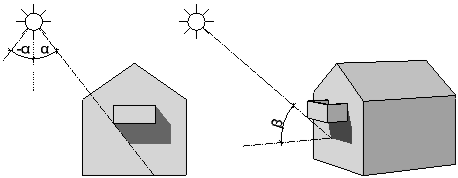
When you select the Consider light setting, the program calculates lights in hidden line images in accordance with the settings for Light angle in view and Light angle to visible axis. This is not a sun study; the program idealizes the light situation!
Using Light angle in view (left / right), you can define the direction of the shadows.
Using Light angle to visible axis (length of shadow), you can how long the shadows are.
|
|
|
alpha: light angle in view, -180° (left) to 180° (right) |
Using Light intensity, you can specify how many shades of color are used for fills and bitmaps. Enter a value between 1 and 100 here. The smaller the value, the darker the image.
Using Fill-in light intensity, you can brighten up shadows and fills. Enter a value 0 through 100 here. When you specify an intensity of 0, the fill-in light is not calculated.
Select Show shadows if you want to display shadows. If you enter negative values for Light angle in view (left / right), the shadows are cast to the left. If you enter positive values, they are cast to the right. The smaller the value, the steeper the shadows. Using Light angle to visible axis (length of shadow), you can control how long the shadows are in isometric views. The greater the value, the longer the shadows.
Adjacent edges
You can specify an angle up to which surfaces are merged in order to make curves appear smoother. Setting a larger angle causes curves to appear as a silhouette.
|
|
|
|
|
Off |
Angle |
Angle |
Adjacent edges of archit. components
You can specify how adjacent edges of architectural components are displayed. This setting is only available if Remove adjacent edges is selected. Otherwise, both options are active by default.
When Display adjacent edges between different surface elements or Display adjacent edges when material changes is selected, adjacent edges are displayed when there are different surface elements (hatching style, pattern, fill) or materials within a component.
Note: To specify whether the surface elements or the material is decisive, open the  Options and make the corresponding setting in the Components and architecture area on the Components page.
When Display adjacent edges for round components is selected, adjacent edges of round components (wall, column, chimney) are displayed. This option is usually switched off.
Special settings
For architectural sections
This setting is not available with associative views.
Result
Display visible edges
When you select the Display visible edges check box, you can see all visible edges. The program uses the format properties you define here.
When you select the  Pen,
Pen,  Line,
Line,  Color or
  Layer check box, the elements are displayed with the format properties set in this dialog box. Otherwise, the elements retain the format properties with which they were drawn.
Display hidden edges
When you select the Display hidden edges check box, Allplan also displays hidden edges. The program uses the format properties you define here.
When you select the Pen, Line, Color or Layer check box, the elements are displayed with the format properties set in this dialog box. Otherwise, the elements retain the format properties with which they were drawn.
Buttons in the border of the dialog box
 Load favorite,
  Save as a favorite
 Reset
Reset
You can use this tool to reset all the entries in the dialog box back to their defaults.
|
(C) ALLPLAN GmbH |
Privacy policy |